Blog

  • How Remote Work and Technology Are Shaping the Future of Work-Life Balance

    How Remote Work and Technology Are Shaping the Future of Work-Life Balance

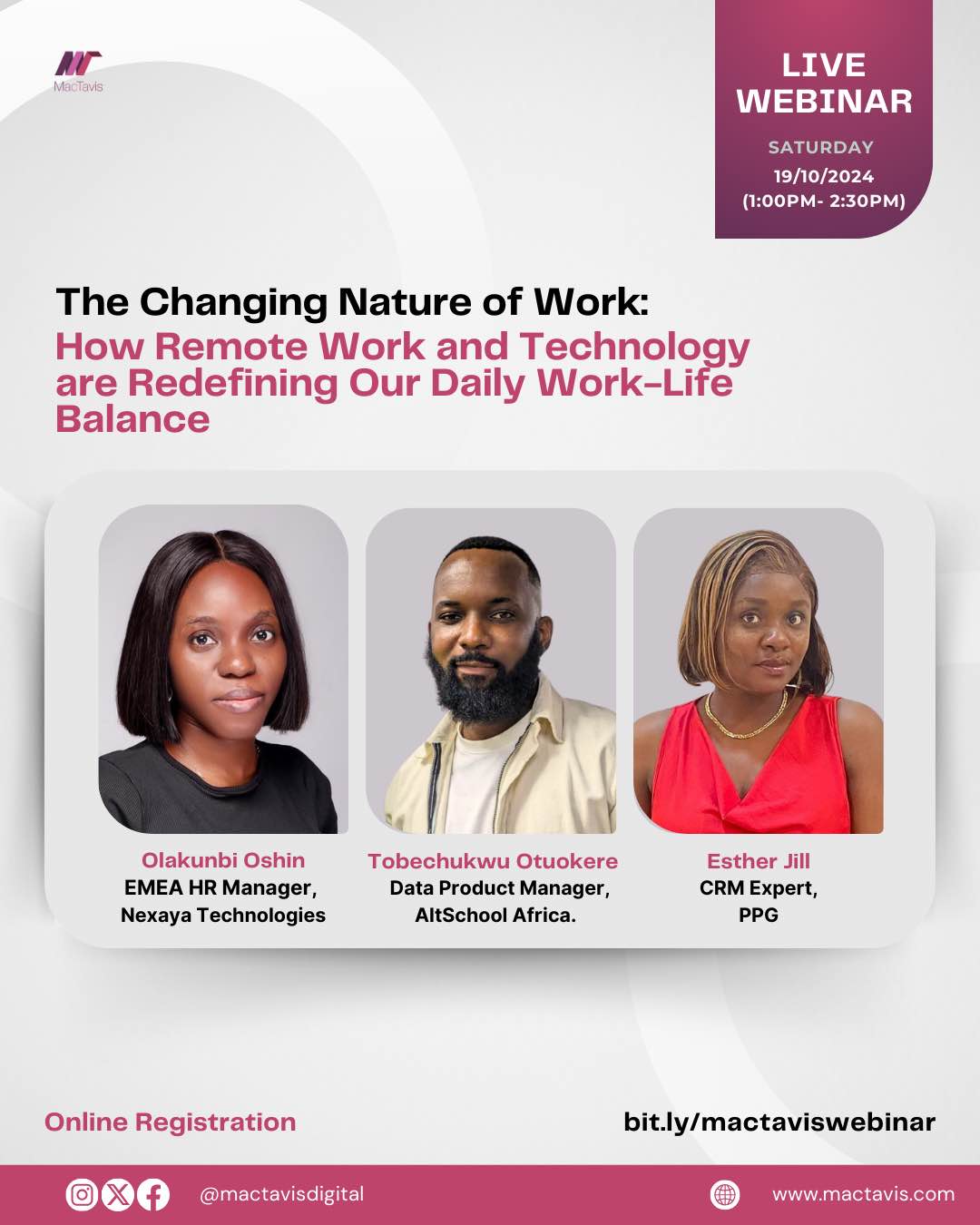
    On Saturday, we hosted a webinar titled “The Changing Nature of Work: How Remote Work & Tech Are Shaping Work-Life Balance”. The event brought together insightful discussions from industry leaders about the evolving workplace, how remote work reshapes traditional work structures, and the balance between professional and personal life. The conversation was filled with practical tips, real-world challenges, and solutions for work-life harmony in the digital age.

    Key Speakers & Takeaways

    1. Olakunbi Oshin – EMEA HR Manager at Nexaya Technologies

    Olakunbi Oshin opened the session by exploring the history of remote work. She pointed out that the concept dates back to 1973, long before the COVID-19 pandemic made it mainstream. She highlighted how the pandemic accelerated the adoption of remote work, creating new job roles such as remote team leaders and virtual assistants.

    However, not all industries, embraced remote work fully. Sectors like banking faced challenges due to the vast amount of sensitive information they handle and the lack of home-based technical infrastructure. Olakunbi also touched on other challenges, such as maintaining employee productivity, dealing with distractions at home, and finding ways to create personal connections with colleagues despite the distance.

    One of the most memorable quotes from her session was, “If everyone decides to work remotely all over the world, it will take the human factor out of work and turn us into machines.” She emphasized the importance of balancing remote work with physical interactions to maintain team dynamics and personal relationships.

    2. Tobechukwu Otuokere – Data Product Manager at AltSchool

    Tobechukwu shared his experiences working both remotely and in-office, expressing his preference for a hybrid work model. He delved into the privacy concerns that come with remote work and how difficult it can be to draw a clear line between work and personal life. One of his key suggestions for overcoming this challenge was to make work more about the outcomes rather than just tracking the number of hours worked.

    Tobechukwu also stressed the importance of effective communication, favoring calls over text-based communication to foster a more personal connection with colleagues. His practical productivity tips included waking up two hours before work to create a structured day, maintaining a to-do list, and prioritizing tasks. Additionally, he highlighted the importance of taking breaks to avoid burnout, an issue that is becoming more prevalent in a remote work setup. He also mentioned using techniques such as the Pomodoro technique to improve productivity.

    3. Esther Jill – CRM Expert at PPG

    As a strong advocate for remote work, Esther Jill provided a contrasting view to Tobechukwu, explaining why she prefers working 100% remotely. For her, the biggest advantage is the flexibility and visibility that remote work offers, allowing her to harmonize her professional and personal responsibilities more effectively.

    Esther also shared her personal experience of transitioning to remote work, which was initially challenging. She overcame these difficulties by creating a dedicated workspace and organizing her day with a to-do list. In her closing remarks, she emphasized the importance of mental health and self-care, stating that achieving work-life balance means harmonizing work with life rather than treating it as two competing forces.

    Audience Q&A Highlights

    The webinar concluded with a Q&A session, where participants raised important questions that reflected the challenges many face in navigating remote work. Key questions included:

    • How to set clear boundaries with employers regarding working outside of office hours?
    • How can managers effectively oversee remote employees given their different personalities and needs?
    • How to manage unavoidable distractions while working from home?

    The Lasting Impact of Remote Work

    The webinar lasted for 1 hour and 41 minutes, filled with in-depth discussions on the future of work. Each speaker brought their own experiences and insights, highlighting both the advantages and the challenges of remote work. From privacy concerns to the importance of physical interactions, this webinar really showed the ongoing evolution of work and its impact on work-life balance.

    As remote work becomes more entrenched in today’s workforce, the need for clear strategies to maintain productivity, personal connections, and mental health has never been more critical. The discussion left us with much to ponder, especially on how technology continues to redefine the way we work and live.

    This webinar was a call to action for organizations and individuals to rethink how they approach work in this new digital era. We thank everyone who participated and look forward to hosting more insightful conversations in future events.

    Missed the Webinar?

    If you couldn’t attend live, no worries! You can listen to the full recording of the webinar here.

    Share your thoughts!

    How are you adapting to remote work? What challenges have you faced in balancing your professional and personal life? Leave a comment below.

    Don’t Miss Our Future Events

    Mactavis Digital will be hosting insightful webinars like this every month so be sure to subscribe to our newsletter to stay updated on upcoming events.

  • Guide to Building a High Performing Real Estate Website

    Guide to Building a High Performing Real Estate Website

    Having a website for your real estate business is an absolute necessity. The real estate market has evolved, and so have your potential buyers. People no longer rely solely on in-person visits or brochures to make decisions; they head online, browsing properties and making inquiries from the comfort of their homes.

    But here’s the kicker: not just any website will do. It’s not enough to have a digital presence. Your real estate site needs to be well-designed and optimized to turn visitors into potential leads and ultimately, buyers. If your site lacks performance, you could be missing out on potential business.

    Your site needs to engage and capture potential clients through an easy-to-use, data-driven experience. In this guide, we’ll walk you through the essential strategies to turn your website into a lead-generating powerhouse.

    1. Understanding Your Target Audience

    Before you start working on your real estate website, it’s crucial to know who your potential buyers are. Your target audience drives every aspect of your website, from the content you create to the design choices you make. Without understanding their needs, preferences, and behaviors, your site might not connect well and struggle to convert visitors into buyers.

    Key Tips for Defining Your Audience:

    • Create Buyer Personas: Paint a detailed picture of your ideal buyers. Are they first-time homeowners? Luxury property investors? Develop profiles that highlight their demographics, income, location preferences, and pain points.
    • Define Useful Filters: Tailor the site experience by segmenting your audience based on property cost (luxury vs. budget), property type, location, and intent (rent vs. purchase). This helps create a personalized experience for every visitor.
    • SEO Insight: Do some keyword research to understand how your audience search online. This will help you match your content and meta tags to their search habits, boosting visibility and ranking. By understanding your audience, you can build a real estate website that provides a personal and relevant user experience, making it more likely to convert visitors into buyers.

    2. Designing a User-Friendly, Responsive Website

    When it comes to your website, design is everything. It’s the first thing people notice, and it can either draw them in or turn them away. A sleek, modern, and easy-to-navigate site not only leaves a great first impression but also keeps visitors interested long enough to become potential clients. A cluttered or slow real estate website means potential clients will click away in seconds.

    Key Tips for a User-friendly Website:

    • Prioritize Mobile Responsiveness: With most prospective homeowners and tenants using mobile devices to search for properties, your real estate website needs to work seamlessly on smaller screens. Ensure images, text, and buttons resize and function properly on all devices.
    • Speed and Navigation: Nothing frustrates users more than slow load times or confusing navigation. Ensure your site loads quickly and that visitors can easily find what they’re looking for with minimal clicks. A smooth, intuitive user experience will keep them on your site longer.
    • High-Quality Visuals and CTAs: Real estate is visual by nature, showcase your properties with top-notch images and videos. Clear, compelling calls-to-action (CTAs) on every page will guide visitors toward the next step—whether it’s scheduling a viewing, contacting an agent, or signing up for updates.

    3. Optimizing Property Listings for Search and Usability

    If you want to really grab the attention of potential buyers and renters, your property listings need to be more than just the basics. They should be carefully put together, visually appealing, and easy to use. Here’s how to make sure your property listings are both user-friendly and search-engine-optimized,

    Key Tips for Optimized Listings:

    •  Prioritize Detailed Descriptions: A detailed listing attracts serious inquiries. Make sure to include important details like price, location, property features, and amenities. But don’t stop there—make the description engaging by highlighting the property’s unique selling points, such as its proximity to important places or special design features.
    •  Make It Visually Stunning: Great visuals can make or break a potential buyer’s first impression. High-resolution images from different angles, along with well-lit interior shots, help prospective clients envision themselves in the space. Adding virtual tours gives visitors an immersive experience, letting them explore every nook and cranny without leaving their screens.
    • Integrate User-Friendly Search and Filter Tools: Make sure your listings have easy-to-use filters based on price range, property size, and features, so users can easily narrow down their searches. Also, integrating map functionality allows potential buyers to see the property’s proximity to schools, transportation links, and other essentials.

    4. Incorporating Lead Generation Tools and Features

    To turn visitors into valuable leads, your real estate website needs to do more than just showcase properties. It should actively engage users and guide them towards taking action. A well-designed site will seamlessly integrate lead-generation tools, turning curiosity into commitment.

    Key Tips to Drive Leads:

    • Strategically Use Forms, CTAs, and Pop-Ups: It is crucial to place these features strategically so they don’t overwhelm users. For instance, putting a CTA like “Get Instant Property Alerts” near the top of a listing can encourage potential buyers to subscribe for updates. Another great way to engage visitors is through live chat, which allows you to address any hesitations or questions they may have in real-time. When visitors feel supported, they’re more likely to provide their contact details.
    • Offer Value-Driven Incentives: Offering downloadable guides, market trend reports, or home-buying checklists in exchange for contact details creates a win-win scenario. These resources help users make informed decisions and position your brand as a trusted advisor in real estate. Remember, people are more willing to give when they receive something valuable in return.
    • Keep Potential Buyers Engaged with Calculators and Neighborhood Info: These features add depth to your site and help visitors envision life in a particular area or understand their financial options. When potential buyers can use your site to figure out mortgage rates or check out local schools, amenities, and commute times, they tend to stick around longer, giving you more chances to grab their attention.
    • Optimize CTAs for SEO and User Intent: Using phrases like “Explore Available Homes” or “Get Personalized Listings” resonates with what potential buyers are seeking. Also, make sure to use action-oriented keywords in your calls to action (CTAs) to boost your search visibility. This will help potential buyers who are ready to take the next step to easily find and follow the path you’ve set out for them.

    5. Analyzing and Refining Your Website’s Performance

    It’s important to keep in mind that your website should always be changing to meet the needs of the people who use it. To make sure your site not only brings in visitors but also turns them into leads, it’s crucial to regularly look at how it’s doing. Using data to make decisions is really important for making the user experience better and increasing the number of people who take action on your site.

    Key Tips for Improving Performance & Conversion:

    • Track User Behavior with Heatmaps and Analytics Tool: Understanding how visitors engage with your site is important for making meaningful improvements. Heatmaps show you exactly where users are clicking, scrolling, and spending the most time, giving you a visual picture of how users interact with your site. You can combine this with analytics tools like Google Analytics to dig deeper into metrics such as where your traffic is coming from, how long people are staying on your site, and which pages they’re leaving from. 
    • A/B Test CTAs, Forms, and Landing Pages: It’s always a good idea to try out different versions of your calls to action, forms, and landing pages to see which design or wording connects best with your audience. Even small changes, like tweaking button colors, updating headlines, or rearranging form fields, can make a big difference in increasing conversions.
    • Automate Reporting for Key Metrics: Set up automated reporting to keep an eye on important stats. Keep an eye on the bounce rate to see how engaged users are, and track lead generation to see how well your call-to-actions and forms are working. Also, make sure to monitor your site’s SEO performance by tracking keyword rankings and organic traffic. Automating these reports will help you stay on top of things and make smart decisions to keep your site running smoothly.

    Conclusion

    Your real estate website is your most valuable digital asset. When optimized for both user experience and conversion, it can transform into a lead-generation powerhouse. But waiting for competitors to gain the upper hand isn’t an option. The time to act is now.

    Investing in a website that not only looks stunning but also drives conversions will set you apart in a crowded market. From detailed property listings to smart lead-generation tools, every element should work together to turn casual visitors into committed buyers.

    At Mactavis Digital, we specialize in creating scalable, results-driven real estate websites designed to capture leads and maximize conversions. Our team of web design and development experts is ready to help you elevate your online presence and turn your website into a lead-generation powerhouse.

    Contact us today for a free consultation and discover how we can build a website tailored to your needs. Time is ticking, and every missed opportunity could mean a lost client. Let’s work together to ensure your website isn’t just another site.


  • Essential Tips for Building a High-Performing Learning Management System (LMS)

    Essential Tips for Building a High-Performing Learning Management System (LMS)

    In our last post, we discussed why you need a Learning Management System to improve how you deliver educational content, manage learners, and streamline your operations. But it’s not just about knowing why, you also need a high-performing LMS to get the best results. In this post, we’ll delve into some key tips to assist you in creating an LMS that fits your organization’s specific requirements and guarantees long-term success. Let’s get started! 

    1. Understand Your Audience and Learning Goals 

    To build a high-performing LMS, you need to understand the people it serves. Understanding who your learners are and what they want out of their learning experience is key to creating an LMS that really works. 

    Start by figuring out who your audience is. Are they employees looking to advance their careers, students trying to learn new things, or professionals aiming for certifications? Each group has different preferences, behaviors, and goals when it comes to learning. Once you’ve nailed down these details, you can tailor learning paths that really speak to them. 

    When you take the time to understand your audience, you’re building a system that creates an experience that truly connects. Learners get more involved when they feel like the content is speaking directly to what they need and want to achieve. And when engagement goes up, so does the effectiveness of your LMS. 

    2. Choose the Right Features and Integrations 

    When creating a high-performing LMS, it’s crucial to equip it with the right tools and features to ensure a seamless learning experience. The more intuitive and accessible your LMS is, the more likely learners will engage and remain committed. 

    Start by prioritizing features that make the user experience simple and straightforward. An easy-to-use interface with clear navigation ensures that learners spend their time absorbing content rather than struggling to use the platform. It’s also essential to ensure mobile accessibility, allowing learners to access the LMS from any device, providing the flexibility to fit into their busy schedules. 

    For increased engagement, consider incorporating gamification. Features like badges, points, or leaderboards can transform the learning process into a more interactive and motivating experience. Learners are motivated to complete courses not only to learn but also to earn rewards and recognition along the way. 

    While selecting LMS features, it’s important to consider future growth. An LMS designed for current needs may quickly become outdated if it can’t scale. Choose features that can adapt as your organization grows. Whether it’s the ability to add more courses, accommodate more users, or support new technologies, scalable features ensure that your LMS remains a long-term solution, rather than a short-term fix. 

    3.  Prioritize User Experience (UX) and Interface Design 

    A great LMS should be effortless for the user to navigate, with intuitive and sleek interface design. The smoother the user experience, the more learners can focus on absorbing knowledge. It’s essential to ensure that every click, scroll or swipe feels intentional and easy. 

    Visually, the LMS should have a modern, clean design that feels inviting and professional, as visual clutter and poor organization can overwhelm users. It’s all about simplicity—keeping the interface streamlined so that the content takes center stage, allowing learners to stay focused on their training objectives. 

    To create an exceptional LMS, it’s crucial to partner with a design agency that specializes in intuitive user interfaces and responsive designs. These experts understand the nuances of UX design and can ensure that your platform works beautifully across all devices. Their expertise in responsive design will ensure a consistent experience regardless of the device your audience chooses to use, whether it’s a desktop, tablet, or smartphone. 

    4. Ensure Robust Security and Data Privacy 

    Protecting sensitive information is very important, especially when it comes to an LMS that holds everything from student details to payment information. Security is not an area to cut corners; it’s the foundation of trust between your platform and its users. Making sure you have strong security measures in place can protect your system from breaches and cyber threats that could jeopardize both your reputation and your learners’ data. 

    Start with SSL encryption to keep data safe as it moves between servers, which helps to keep sensitive information away from unauthorized users. Adding two-factor authentication provides an extra layer of security by making users verify their identity through multiple means before gaining access. It’s also important to conduct regular security audits to identify vulnerabilities before they turn into major problems. By actively defending your Learning Management System, you decrease the risk of a serious data breach. 

    In addition to these technical measures, make sure to comply with local and international data privacy regulations to instill confidence. Whether it’s GDPR or other global standards, adhering to these regulations isn’t just about avoiding legal risks, it’s about showing users that their privacy is important to you. 

    5. Plan for Continuous Improvement and Updates 

    When it comes to a good Learning Management System, it’s not something you build once and forget about. Just like your organization, it needs to change, grow, and get better over time. With technology always advancing, learner expectations evolving, and industry standards shifting, your LMS should be able to keep up. 

    One of the best ways to keep your platform relevant is to schedule regular updates. These updates not only bring in new features but also fix any issues that pop up. By getting feedback from your learners, you can figure out what needs improvement and find opportunities for new features. This ongoing conversation with users ensures that your Learning Management System stays in line with their needs. 

    Use learner performance analytics to guide these improvements. By analyzing which modules are popular and which areas learners struggle with, you can adjust how the content is delivered and bring in more helpful resources. This data-led approach leads to a more personalized learning experience and better outcomes for your users. 

    Set up automated reporting systems to track both learner progress and system performance. These reports give you real-time insights into how your Learning Management System is working and where it can be improved. 

    Conclusion

    Your Learning Management System is the backbone of your digital learning efforts. Investing in a high-performing system not only enhances the learning experience but also drives meaningful outcomes for both your learners and your organization. A well-constructed LMS streamlines operations, improves engagement and ultimately supports your business goals. 

    How Mactavis can help you build a high-performing LMS 

    At Mactavis Digital, we excel at creating custom, high-performing Learning Management Systems tailored to meet your specific needs. Our systems are designed to grow alongside your organization, ensuring you’re always equipped to handle future challenges and opportunities. 

    Don’t wait until your current system holds you back. The time to upgrade is now. Get started with a free consultation today and let us show you how we can help bring your ideal LMS to life. Let’s build a system that works for you! One that’s scalable, secure, and ready for the future. 

    Contact us today for a free consultation, and let’s embark on this journey together. We’re here to help you bring your vision to life, creating a cutting-edge platform tailored to your unique needs. Time is of the essence, let’s make your vision a reality before your competition does! 

  • 5 Reasons Why You Need a Learning Management System (LMS)

    5 Reasons Why You Need a Learning Management System (LMS)

    90% of audiences today prefer learning online to traditional learning methods. This shows how essential it is to have a central platform for managing and sharing educational content. However, a lot of educational programs and organizations still stick to old-fashioned methods, which end up being disorganized, costly, and time-consuming. Without a proper Learning Management System (LMS), managing multiple training programs, tracking learner progress, and maintaining consistent quality across different locations can be a real headache. These inefficiencies can really reduce the overall impact of your training efforts. 

    What is a Learning Management System? 

    A Learning Management System (or LMS), is a software platform designed to organize, execute, and monitor educational or training programs. It simplifies the process of creating, distributing, and tracking training materials, making it easier for organizations, schools, and individual educators to manage a wide range of learning activities.

    Main Features of an LMS

    1. Course Creation
    2. User Management
    3. Progress Tracking
    4. Exams & Quizzes
    5. Certification Issuance
    6. Paid Content & Payment Management
    7. Learner Onboarding
    8. Collaboration Tools

    All these features are versatile enough to be used in various settings, from businesses providing employee training to educational institutions, tech schools, traditional skill schools, content creators, and life coaches offering development courses. 

    The primary goal of an LMS is to make the learning process seamless, digital and easily accessible.

    In this blog post, we’ll be discussing the benefits that come with having/integrating an LMS into your training and educational processes.

    1. Time & Cost Reduction

    A Learning Management System helps with eliminating the need for expensive, time-consuming in-person training sessions and administrative processes. You can save a lot of time and money on training expenses by moving to an LMS. Traditional in-person training can be very expensive considering the cost of travel, reserving a location, and purchasing materials.

    With an LMS, no matter where your intended audience is located, you can provide them with high-quality training for a small fraction of the price, you may host virtual sessions, provide digital resources, and maintain an ongoing learning environment. You can actually save more than 70% on training costs by utilizing an LMS. 

    2. Enhanced Communication and Collaboration 

    Good communication and teamwork are essential for a productive learning environment. A learning management system offers a digital platform for communication between instructors and learners, making the educational experience more engaging and interactive.  

    Discussion boards, messaging, and real-time chat are just a few of the features that an LMS offers to assist lower the barriers that separate students and teachers. It’s simple to start discussions, ask questions, exchange ideas, and receive prompt feedback thanks to these features. 

    An LMS’s ability to promote collaboration through features like shared workspaces and group projects is another benefit. These resources enable students to collaborate on tasks regardless of their location, helping them develop teamwork and interpersonal skills. 

    3. Improve Tracking and Reporting 

    Beyond delivering content, a good Learning Management System monitors and reports on student progress, providing you with insightful data about the efficacy of your training. Every interaction is monitored by an LMS, including quiz results and course completions. This data helps instructors and administrators keep an eye on individual and group performance, spot areas where learners might be struggling, and adjust training programs as needed. To continually improve your training programs, you can keep track of each learner’s progress, spot skill gaps, and produce thorough reports.  

    An LMS’s reporting features are essential for continuous development. Administrators can generate comprehensive reports on a range of parameters, including completion rates, exam scores, and engagement levels. These reports assist in assessing how effective your training programs are, ensuring that learning goals are satisfied and that the content remains interesting and relevant.

    4. Efficient Management and Organization 

    An LMS consolidates all your training programs and activities into one easy-to-use platform. It provides a single platform to handle everything, from organizing materials and scheduling sessions to managing learner enrollment. Whether you’re managing a tech school with multiple courses or a traditional skill school offering various training programs.

    By centralizing these functions, an LMS reduces the administrative workload, minimizes errors, and improves overall efficiency. Learners and instructors benefit from easy access to resources, automated reminders, and notifications, ensuring everyone stays informed and engaged.

    5. Deliver High Quality Training Programs 

    The success of your educational initiatives depends on the quality of your training programs. An LMS ensures that you consistently deliver high-quality training tailored to the diverse needs of your audience.

    One of the significant advantages of an LMS is its flexibility in supporting various training methods, whether e-learning modules, live webinars, or blended online and in-person sessions. This adaptability ensures that your training is accessible to everyone, regardless of their location or learning preferences.

    For instance, if you’re a life coach onboarding new clients or a tech school upskilling students, an LMS ensures that they get top-notch training whenever and wherever they need it.  As your program expands, the LMS gives you a flexible structure to welcome more learners, add new courses, and tackle big projects, keeping your training effective and on point. 

    Conclusion 

    Introducing a Learning Management System into your organization can do more than simply make things easier; it can completely change the way you manage training. By centralizing all your training efforts, an LMS increases efficiency. It improves teamwork and communication, provides advanced tracking and reporting, streamlines management, and reduces the amount of administrative work. It also guarantees that your training courses are scalable, high-quality, and consistent. 

    Why you should choose Mactavis Digital 

    At Mactavis Digital, we specialize in helping educators, coaches, and organizations integrate Learning Management Systems seamlessly and effectively. Our custom solutions ensure that your LMS aligns perfectly with your objectives, providing the tools needed to enhance productivity, increase engagement, and drive success.

    Click here to get in touch with us to schedule a free consultation and we will help you make sure your LMS is customized to your requirements and delivers maximum value. Let’s work together to elevate your organization’s learning and development.

  • 7 Reasons Why Your Law Firm Needs a Website

    7 Reasons Why Your Law Firm Needs a Website

    The legal landscape is evolving, and so are the expectations of potential clients of lawyers and legal firms. The absence of an online presence is a glaring oversight for any modern law firm. 

    Without a website, your law firm is likely missing out on many potential clients. 

    In this present day, when someone needs legal services, they usually look it up online first. Credibility, convenience and assurance that they are making the proper decision are what they seek. A well-designed website will serve as the online representation of your legal practice, offering clients confidence, displaying experience, and giving vital information. 

    However, many legal firms continue to conduct business without a website, restricting their reach and accessibility, despite the obvious benefits. This weakens their competitive advantage in an increasingly saturated market and makes it more difficult for them to draw in new clients.  

    Having a strong internet presence is now essential; it is not optional. Failing to do so puts your law firm at risk of being overshadowed by competitors who are more digitally adept, which could result in the loss of potential clients who prefer the ease of use and speed of obtaining legal advice online.  

    This blog post will examine seven solid reasons why your law firm needs a website, showing how having a good online presence can increase clientele, establish a reputation, and guarantee that your firm survives in the contemporary world. 

    1. Modern Client Behaviour

    The convenience of a quick internet search allows potential clients to easily access a plethora of information about various legal services and firms. This immediate access to information significantly influences their decision-making process. Nowadays, clients anticipate having access to case studies, attorney profiles, client testimonials, and thorough description of services. Having a strong online presence ensures that people will find your firm when they need legal help, making you an attractive choice. Typically, prospective clients begin their search with a general query about their legal problem, then narrow it down to find law firms that can help address their needs. 

    Moreover, modern clients tend to trust the results online, often equating a firm’s digital presence with its pedigree, excellence and proficiency. Thus, having a website that ranks well in search engine results is vital for capturing the attention of prospective clients at the very start of their journey. 

    You are not included in this first set of considerations if your firm does not have an online presence. Furthermore, many modern clients frequently assume a company’s digital presence indicates its authenticity and expertise, placing a high value on the outcomes they discover there. Therefore, it is essential to have a website that performs well in search engine results to draw in potential clients right away. 

    2. Credibility and Trust 

    A professional website creates confidence and demonstrates the dependability and credibility of your legal practice. It gives you a platform to present your firm’s achievements, experience, and knowledge of your firm, improving your standing. 

    A website allows you to present your firm’s narrative compellingly and authentically. Through attorney bios, detailed service descriptions, and client testimonials, you can convey your firm’s unique value proposition and build a rapport with prospective clients before any direct interaction occurs. Furthermore, a well-maintained website, with up-to-date content and a user-friendly interface, reflects your commitment to professionalism and client service. 

    In addition to boosting credibility, a website will demonstrate your firm’s technological savviness, which is important to modern clients who value efficiency and accessibility. Features such as online consultation booking, live chat support, and resourceful blog posts can significantly enhance client engagement and satisfaction. These elements not only improve the user experience but also reinforce the perception of your firm as a forward-thinking and client-focused organization. 

    3. Increased Visibility and Reach 

    Increased visibility and reach are paramount for attracting new clients. A well-optimized website significantly enhances your firm’s search engine ranking, making it more likely that potential clients will find you. With the right SEO strategies, your law firm can appear on the first page of search results, positioning you prominently where clients are most likely to click. 

    Search Engine Optimization (SEO) involves various techniques, such as keyword optimization, high-quality content creation, and backlink building, all designed to improve your website’s ranking on search engines like Google. By incorporating relevant keywords that potential clients are likely to search for, such as “divorce lawyer” or “business attorney,” your website can rise to the top of search results. Moreover, regularly updating your website with informative and engaging content, such as blog posts and case studies, signals to search engines that your site is active and relevant, further boosting your rankings. 

    The advantage of high search engine visibility is clear: it increases the likelihood that potential clients will visit your website. This increased traffic can lead to more inquiries and, ultimately, more clients. A strategic SEO plan transforms your website from a static online brochure into a dynamic tool for client acquisition. 

    4.  Client Convenience (24/7 Accessibility) 

    Client convenience is a crucial factor in choosing a legal service provider. Unlike a physical office, a website is open 24/7, providing a constant point of access to your firm’s resources and contact information. 

    Potential clients typically conduct their research outside of business hours, whether late at night or early in the morning. Having a website ensures that your firm is always available to meet their needs, regardless of the time. It allows clients to explore your services, read about your expertise, and even initiate contact through online forms or chatbots whenever it suits them. 

    Furthermore, a website can include features such as an FAQs section, downloadable resources, and informative blog posts, all of which empower clients to educate themselves about their legal issues before reaching out to your firm. This not only enhances their experience but also streamlines your intake process by providing clients with the information they need upfront. 

    5.  Showcase Your Expertise 

    One of the most effective ways to showcase your expertise is through having a website. Regularly updated content, such as blogs, articles, and case studies, can highlight your knowledge and position your firm as a thought leader in the legal field. By addressing common legal questions, discussing recent legal developments, and sharing success stories, you provide valuable insights that can attract and retain clients. 

    Blog posts and articles allow you to delve into specific areas of law, demonstrating your firm’s proficiency and keeping your audience informed about pertinent issues. Case studies, on the other hand, offer a detailed look at your firm’s capabilities and successes, providing potential clients with tangible evidence of your expertise. This consistent stream of high-quality content not only engages visitors but also boosts your search engine rankings, further enhancing your online visibility. 

    6.  Better Client Engagement 

    Interactive features on your website can significantly enhance client engagement and streamline the process of obtaining legal assistance. Tools such as chatbots, contact forms, and scheduling systems provide immediate, personalized interaction, making it easier for clients to connect with your firm. 

    Chatbots and Knowledge bases are features that can answer common questions, provide basic legal information, and direct clients to relevant resources, all in real-time. This instant communication fosters a positive client experience by addressing their needs promptly. Contact forms allow clients to reach out with specific inquiries or request consultations, facilitating a seamless communication channel between potential clients and your firm. Online scheduling tools further simplify the process, enabling clients to book appointments at their convenience without the need for back-and-forth phone calls. 

    These interactive elements not only enhance the user experience but also demonstrate your firm’s commitment to accessibility and client service. By providing multiple avenues for engagement, you make it easy for clients to take the next step in seeking legal help. 

    7. Competitive Advantage

    A well-designed website can provide a substantial competitive edge to your firm. Your company will stand out from those without an online presence and from those with antiquated, badly designed websites if it has a polished, user-friendly website. It reflects the modernism, professionalism, and attention to details of your law firm.

    It is critical to emphasize what makes your company special. This can contain your areas of expertise, noteworthy accomplishments, or unique client-service methodology. Posing these differentiators prominently on your website helps you tell a story that appeals to prospective customers.  

    Additionally, a well-designed website demonstrates trustworthiness and credibility. Clients are more likely to think highly of your company and take it seriously when they visit a well-designed, informative website.  

    Conclusion 

    If you want your law firm to thrive in the modern legal landscape, then you must leverage the power of a professional website from increasing visibility to engaging clients and enhancing your firm’s credibility. Don’t miss out on the vast opportunities the digital world offers. Investing in a strong online presence is a strategic move that will drive growth, attract new clients, and secure your firm’s position in a competitive market.

    How Mactavis Can Help your Firm Grow

    At Mactavis Digital, we specialize in empowering Law firms like yours to thrive in the digital age. We can help you take advantage of the opportunity to invest in a professional website. You are only a few steps away from having the chance to turn your online presence into an effective tool for drawing and keeping clients. 
    Click here to get in touch with us to schedule a free consultation and see how we can help you create a website that attracts visitors and turns them into loyal clients. Our team of experts is ready to partner with you to create a customized solution that satisfies your unique needs and goals. 

    Are you ready to boost the success of your law firm and take it to new heights online?